Starzip, 2026 · Internal content tool design and build · Design tooling
The problem
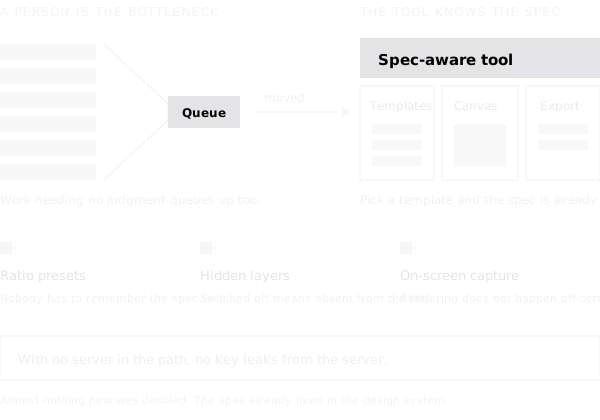
Announcement images, banners, share cards: output whose format was already fixed still had to pass through a designer's queue every time. It was not work that needed judgment, only text and images placed into a settled frame.
When that queue grows, two things happen. Whoever is in a hurry builds outside the spec and the brand splits, and whoever is not in a hurry does not build at all. Both undo the reason for having a spec.
The call: I built the tool
Rather than adding people, I built an editor that knows the spec. Templates, layers, and assets on the left, the canvas in the middle, design and export on the right. Choosing a template means the spec is already satisfied, and all the user does is put in the words and the pictures.
I did not skip what an editor is expected to have: deck-level undo and redo, layer search, a command palette, background presets. Miss any one of them and people go back to the tool they know, and the moment they do the spec splits again.
Export was the real problem
The time went not into editing but into export.
- Do not leave ratios for people to remember. Platform ratios and tone were bundled into presets. Most of what a spec-aware tool is worth sits right here
- Hidden layers were showing up in the output. Something switched off on screen but present in the file is the kind of error a user is unlikely to catch. Export was fixed to see the same thing the screen sees
- Capturing off-screen produced a blank image, because rendering does not happen off-screen. The capture target now sits on-screen for the duration of the capture
Removing the server
At first the generation feature went through a server route. I tore that wiring out and replaced it with an adapter called directly from the browser. The whole tool ships as static files.
Going static made deployment easier, but the larger reason was that users bring their own key. A key that passes through a server gives the server a place to leak it, and that place should be removed rather than guarded by care. With no server, nothing leaks from the server.
Result
Fixed-format output stopped passing through a queue. Built in about five working days, counted from the days that left commits. It went that fast because almost nothing new was decided. The spec already lived in the design system, and the tool only had to read it.