Starzip, 2026 · Documentation architecture and process design · Documentation
369 Documents by category
The problem
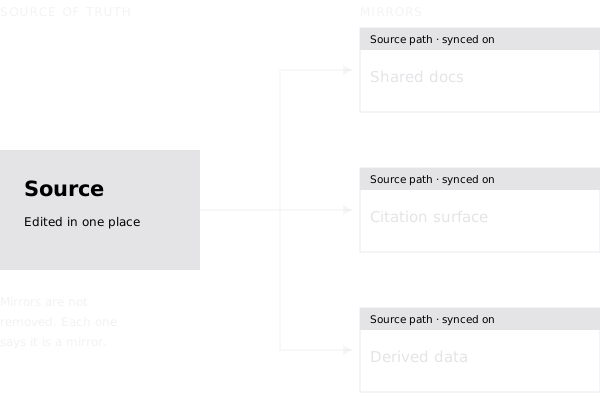
The same policy lived in two places: the repository and the shared wiki. The stated principle was "the repository is the source of truth," but non-engineering colleagues did not have a path that took them through the repository day to day. What they actually opened was the wiki, and nothing on those pages said they were copies.
So stale values were cited with confidence. At one point a duration that had already changed was still sitting in a copy, and a reader had no way to know it was old. A copy emits no signal at all that it is telling you something false.
The decision
Removing the mirrors had already failed once. Forbidding the place people look does not change where they look. So I went the other way.
The mirror was made part of the official procedure. Creating a new source document means creating its mirror in the same unit of work. Three conditions came with that.
- A mirror is a summary, not a copy. Duplicate the full text and you have two documents, and two documents will diverge. A summary sends the reader to the original by construction
- A banner at the top pins the source path and the sync date. Without it a mirror simply reads as the source. The stale-value incident happened along exactly that path
- Editing the source means reconciling the mirror in the same unit of work. A half-updated mirror is worse than no mirror. A mirror whose updates have stopped holds an old value with full confidence
One entrance for citation
The second problem was citation. When "where is the source of truth" has several answers, everyone who cites opens a different one. The place non-engineering colleagues go to cite our standards was fixed to a single entrance. However many items sit beneath it, the entrance is one.
The cost was written down honestly. That index is maintained by hand, not automatically. Publishing a new policy has to include listing it, and a policy that misses its listing becomes, to anyone citing it, a thing that is not in the source of truth. Not pretending an un-automated step is automated was the most important part of this design.
Figures used in policy are not embedded in document bodies either. They live in a single list that the screens read from. Scatter a number across documents and a few copies will always survive a change, and the survivors get cited more often than the corrected ones.
Repeat mistakes belong in checks, not in prose
Once the document system stood up, the same problem turned up somewhere else. The default response to a mistake happening a second time was to add one more line of caution to a document. A few months of that leaves hundreds of lines of cautions, and nobody reads to the end of that document. Worse, nobody knows when a given line stopped being relevant.
So repeat mistakes stopped accumulating as prose and moved through a procedure that turns them into machine-enforced checks. Four steps: capture, classify, promote, retire. Once promotion is complete the original line is reduced to a single pointer or deleted. Restating in prose what a check already catches makes that prose pure cost. The triggers were fixed too: the second recurrence, the first incident, and any discovery that a reference document and reality had drifted apart.
Retirement is the part that matters. Registers like this almost always grow in one direction, because reasons to add appear on their own and reasons to remove are nobody's job. So on a set cadence the document is reread and lines that no longer fire are removed. The document exceeding a certain length is itself a trigger. Length was made into a signal.
What the checks cannot catch, stated plainly
Adding guards taught me that the existence of a check does not imply coverage.
- Some checks only run across a registered list. A screen that is not on the list holds a stale value under a green check
- Some checks warn rather than block. A warning does not stop anything, so a person has to open the result. Unopened, it may as well not exist
- Some checks compare against a list maintained by hand. Change a reference value and that list has to be corrected in the same unit of work. When I actually audited one, most of its entries were out of date
All three are documented. Unless you write down the difference between "a check exists" and "the rule is being followed," a green light starts to be the reason people stop looking.
The outcome
Rather than trying to stop documents from multiplying, each document now states its own standing. "Which of these is current" is answered on screen the moment the document opens. And a substantial share of rules previously held together by cautions now fire automatically at commit time and at authoring time. As the list a person has to remember got shorter, what remains on it is the part that genuinely needs human judgment.